
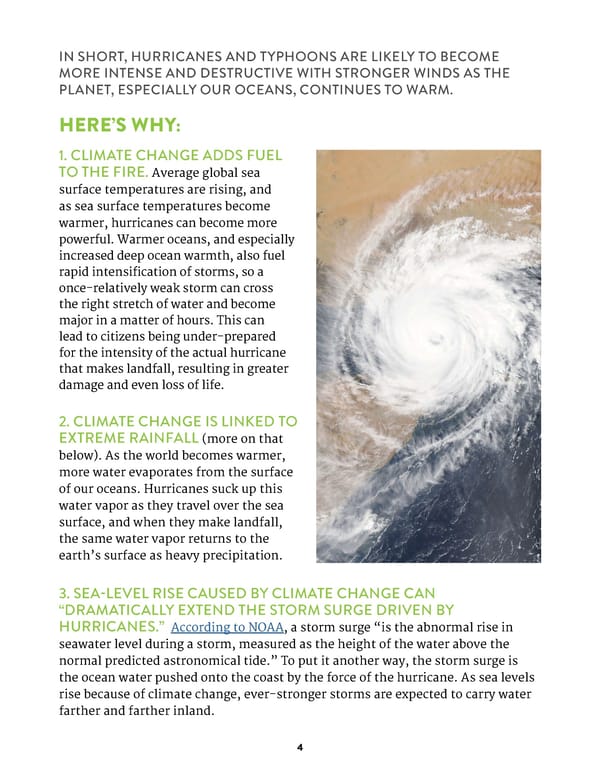
IN SHORT, HURRICANES AND TYPHOONS ARE LIKELY TO BECOME MORE INTENSE AND DESTRUCTIVE WITH STRONGER WINDS AS THE PLANET, ESPECIALLY OUR OCEANS, CONTINUES TO WARM. HERE’S WHY: 1. CLIMATE CHANGE ADDS FUEL TO THE FIRE. Average global sea surface temperatures are rising, and as sea surface temperatures become warmer, hurricanes can become more powerful. Warmer oceans, and especially increased deep ocean warmth, also fuel rapid intensification of storms, so a once-relatively weak storm can cross the right stretch of water and become major in a matter of hours. This can lead to citizens being under-prepared for the intensity of the actual hurricane that makes landfall, resulting in greater damage and even loss of life. 2. CLIMATE CHANGE IS LINKED TO EXTREME RAINFALL (more on that below). As the world becomes warmer, more water evaporates from the surface of our oceans. Hurricanes suck up this water vapor as they travel over the sea surface, and when they make landfall, the same water vapor returns to the earth’s surface as heavy precipitation. 3. SEA-LEVEL RISE CAUSED BY CLIMATE CHANGE CAN “DRAMATICALLY EXTEND THE STORM SURGE DRIVEN BY HURRICANES.” According to NOAA, a storm surge “is the abnormal rise in seawater level during a storm, measured as the height of the water above the normal predicted astronomical tide.” To put it another way, the storm surge is the ocean water pushed onto the coast by the force of the hurricane. As sea levels rise because of climate change, ever-stronger storms are expected to carry water farther and farther inland. 4
 Extreme Weather and the Climate Crisis Page 3 Page 5